
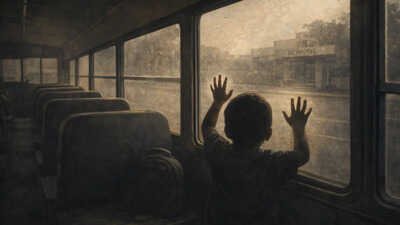
He was four years old.
On a February morning in Noida, he boarded his school bus like any other day. He was tired, perhaps. He fell asleep on the way to school.
When the bus reached, the driver noticed a mechanical issue. Children were transferred to another vehicle. In the chaos, no one checked the seats. No one counted heads. No one noticed a sleeping child.
The bus was driven to a remote parking yard, 25 kilometers away. Locked. And left.
For seven hours, a four-year-old sat alone, terrified, in a dark, locked bus. When he was finally found, he was drenched in sweat, dehydrated, and traumatized.
How Did This Happen?
This wasn’t malice. It wasn’t criminal intent. It was something far more frightening: systemic failure.
- The driver relied on memory. After a long, tiring route, he assumed all children had gotten off.
- Attendance was manual. The school marked him absent because he never arrived in class. The transport log marked him present because he boarded. No system connected the two.
- There was no checklist. No mandatory walkthrough. No sensor to detect a child still inside.
- Parents were notified hours later. By the time anyone realized he was missing, he had already been locked inside for hours.
The Hard Truth About Human Supervision
We want to believe that caring adults will always notice a missing child. But science tells us otherwise.
- Inattention blindness — When we’re busy, our brains filter out information. A driver focused on a mechanical issue won’t “see” a sleeping child.
- Memory failure — After a long route with multiple stops, counting heads becomes a blur. Drivers forget.
- Assumption errors — “Someone else must have checked.” But when everyone assumes, no one checks.
The Noida Case Is Not Isolated
Incidents of children being left in school vehicles happen every year. In some cases, children have died from heatstroke. In others, they’ve been found hours later, lucky to be alive.
The pattern is always the same:
🚫 Manual attendance
🚫 No digital tracking
🚫 No exit checklist
🚫 No parent alert system
Technology Can Do What Humans Cannot
This tragedy was 100% preventable. Not by asking drivers to “be more careful,” but by building systems that make forgetting impossible.
The Class Cabs “Child-Check” Protocol
Class Cabs eliminates the risk of children being left behind through a three-tier technological safeguard:
Step 1: Digital Check-In
Every child’s entry is logged via RFID or facial recognition when they board. No manual registers. No guesswork.
Step 2: Continuous Tracking
The child’s presence is tracked throughout the journey. Parents receive real-time updates.
Step 3: Mandatory Check-Out
Here’s the crucial part — the driver’s app will not allow the bus to be locked until every child who checked in has checked out at school. If a child is still onboard, the dashboard flashes an “Onboard Warning” instantly to the driver and school admin.
The bus cannot lock. The driver cannot leave. The child cannot be forgotten.
Conclusion
The Noida child survived. Some children haven’t.
Every day, in thousands of schools across India, drivers finish their routes, lock their buses, and walk away — hoping they haven’t missed anyone. Hope is not a safety system.
We owe it to every child to replace hope with certainty. To replace memory with technology. To replace “I think I checked” with “I know because the system won’t let me forget.”
Because a sleeping child should never become a forgotten one.